Words That Sound Like Nonsense (But Aren't)
A community-built catalog from r/etymology.
1. How this list came to be
The project began with a simple Reddit post:
“I've been collecting English words that sound completely made up, even though they're legitimate and have long histories behind them. Things like ‘hullabaloo,’ ‘kerfuffle,’ ‘gobbledygook,’ ‘skedaddle,’ and ‘whippersnapper.’ They all have proper definitions and etymologies, but to the ear they feel like playful nonsense.”
The thread filled quickly with suggestions: dialect relics, comic pseudo-Latin, Yiddish loans, onomatopoetic inventions, and words that sound like they wandered in from an 18th‑century farce. Some of them look like serious scholarly Latin on the page and still feel faintly ridiculous when you say them aloud.
Several thoughtful commenters pointed out a crucial thing:
All words are invented. English, like every language, is a long record of people making things up and then persuading other people to use them.
They are, of course, correct. So the framing of this list shifted slightly. This is not a list of “invented words” (they all are). It is:
A catalog of words that sound like nonsense to the modern ear — even though every one of them has a real meaning and a real history.
Every unique word suggested in the thread was collected, normalized for spelling where necessary, and given a short, plain-language gloss. The goal here is not exhaustive etymology but a kind of curated map: what sounds like nonsense, where did it come from, and what work does it do in the language?
2. Alphabetical catalog: brief definitions
Below is the full list, alphabetized, with short definitions focused on current use and recognisable meaning.
- absquatulate — to run off or abscond, especially in a hurry.
- acephalous — literally “headless”; lacking a leader or governing head.
- agog — highly excited or eager.
- ahuacatl — older form behind avocado (from Nahuatl; literally “testicle”).
- avoision — a blend of avoidance and evasion, especially in tax-law slang.
- balderdash — senseless talk; nonsense.
- ballyhoo — loud or sensational publicity; a fuss.
- bamboozle — to trick or deceive.
- beary — bear-like or full of bears; sometimes playful slang for “a lot of bears.”
- behoove — to be appropriate or necessary for; “it behooves you to…”
- bloviate — to speak at length in a pompous, inflated way.
- boondocks — remote, rural, out-of-the-way areas.
- boonies — informal variant of boondocks.
- borborygmus — a rumbling or gurgling noise from the intestines.
- brouhaha — an uproar or noisy fuss.
- bumbershoot — humorous term for “umbrella.”
- bupkis — nothing at all; “zip,” often in a dismissive sense.
- burglarize — to break into and steal from (American back-formation from burglar).
- catawampus — askew, crooked, or out of alignment.
- catamaran — a boat with two parallel hulls.
- cattywampus / cattywompus — variants of catawampus; crooked, diagonally positioned.
- chirality — property of not being superimposable on your mirror image (left/right-handedness in chemistry and math).
- chutzpah — audacity; bold nerve.
- cromulent — humorous coinage meaning “acceptable, legitimate” (from The Simpsons).
- cockamamie — ridiculous, implausible, or nonsensical.
- combobulated — joking back-formation from discombobulated; meaning “put together, functioning.”
- confusticate — humorous blend meaning “confuse or perplex badly.”
- contrafibularities — comic pseudo-Latin term (from British comedy) for “nonsense or obstruction.”
- cubicularius — historical/Latin: chamberlain or attendant of a sleeping chamber.
- deasil — clockwise, “sunwise.”
- defenestrate — to throw someone or something out of a window.
- defenestration — the act of throwing something or someone out of a window.
- defibrillate — to restore normal heart rhythm with an electric shock.
- dingus — informal term for a gadget or thingamajig; sometimes a mild insult.
- dilly-dally — to waste time; to dawdle.
- discombobulate — to confuse or upset; to throw into disorder.
- donnybrook — a wild brawl or uproar, especially involving many people.
- doodad — a small decorative object or gadget.
- doohickey — placeholder name for an object whose proper name is forgotten.
- doubloonie — playful blend of doubloon and loonie; a fanciful coin term.
- didgeridoo — Australian Aboriginal wind instrument, a long wooden tube.
- flabbergasted — extremely surprised or shocked.
- flibbertigibbert / flibbertigibbet — a frivolous, flighty, or chatterbox person.
- furze — another word for gorse, a spiny yellow-flowered shrub.
- gaol — British spelling of jail.
- gallivant — to roam about for pleasure or excitement.
- glitch — a sudden, usually minor malfunction.
- glippish — obscure/dialectal; used for “slippery, uncertain, or glib” in some contexts.
- gobsmacked — utterly astonished; shocked into silence.
- guacamole — avocado-based dip or spread.
- gullywusher / gullywasher — colloquial terms for a very heavy rainstorm.
- haberdasher — a dealer in men's clothing or small sewing items.
- haberdashery — shop selling men's clothing or sewing notions.
- higgledy-piggledy — in confusion or disorder; jumbled.
- highfalutin — pompous or pretentious.
- hooligan — a violent or rowdy troublemaker.
- hootenanny — an informal folk-music gathering; also “thingamajig” dialectally.
- hubbub — a loud mixture of voices; uproar.
- hugeous — humorous nonstandard form of huge; “enormous.”
- interfrastic — rare / playful pseudo-technical term, usually for “between phrases.”
- jackanape — an impudent or mischievous person.
- kibitzing — giving unsolicited advice, especially from the sidelines.
- kitty-corner — diagonally across from.
- lackadaisical — lacking enthusiasm or determination; lazy.
- la-di-da — affectedly refined, pretentious, or dismissive.
- latinist — a specialist in the Latin language.
- lollygagging — idling about aimlessly; wasting time.
- loonie — Canadian one-dollar coin.
- lolapalooza — variant of lollapalooza: something outstanding or exceptional.
- london — here likely a joking or context-specific use; standardly, the capital of the United Kingdom.
- malarkey — nonsense; insincere talk.
- matutinal — relating to the morning; occurring early in the day.
- melifluous — (almost certainly intended as mellifluous) having a smooth, sweet sound.
- milquetoast — a timid, unassertive person.
- mulligatawny — a spiced soup of Anglo‑Indian origin.
- namby-pamby — weak, feeble, or overly sentimental.
- nanuq — Inuktitut for “polar bear” (often seen as nanuq or nanook).
- nicker — British slang for “one pound”; also the verb “to neigh” (of a horse).
- nincompoop — a foolish or silly person.
- obflisticate — playful pseudo-word in the spirit of obfuscate; to confuse utterly.
- ojamaflip / oojamaflip — British placeholder term like “whatchamacallit.”
- onomatopoeia — word formed to imitate a sound (e.g., buzz, hiss).
- pajandrum — variant of panjandrum; an important-sounding but pompous person.
- palindrome — word or phrase that reads the same forwards and backwards (e.g., level, racecar).
- piffle — trivial nonsense.
- poppycock — empty or foolish talk.
- popinjay — a vain, preening person; originally a parrot.
- prothonotary — a senior clerk or notary in some legal systems.
- recombobulation — humorous opposite of discombobulation; putting things back in order.
- schlep — to drag or carry with effort; also, a tedious trip.
- schlocky — cheap, tasteless, or shoddy.
- schmear — smear or spread, especially cream cheese; also “little extra” in some dialects.
- schmooze — to chat informally, especially to gain favor.
- scuffer — dialect term for a rough fight or someone who scuffs.
- shebang — as in “the whole shebang,” meaning everything, the whole affair.
- shenanigans — secretive or dishonest activity; playful mischief.
- shilly-shally — to hesitate or dither.
- simoleon — slang for a dollar (especially in older American usage).
- skewiff — British/Irish slang for “askew, crooked.”
- skosh — a small amount.
- sneeze — sudden, involuntary expulsion of air from the nose and mouth.
- snicklefritz — affectionate term for a mischievous child in some dialects.
- snood — a net or band worn over the hair at the back of the head.
- spuddle — dialect for “to work ineffectually; to fuss about.”
- susurration — a soft, whispering or rustling sound.
- switheroo — variant of switcheroo; a sudden unexpected substitution.
- switcheroo — a surprise switch or reversal.
- tatterdemalion — person in ragged, tattered clothing.
- tchotchke — small decorative object; knickknack.
- territory — standard word, but its rhythm can feel oddly Latinate in isolation.
- terror tree — phrase likely from a specific source; here, a vivid compound coined or quoted by a commenter.
- thingamabob — generic name for an unnamed object.
- thingamajig — similar placeholder for an object whose name you can't recall.
- thneed — fictional multipurpose garment from Dr. Seuss's The Lorax.
- toonie — Canadian two-dollar coin.
- transmogrifier — machine that changes things into something else (from Calvin and Hobbes).
- transmogrify — to transform in a surprising or bizarre way.
- twitterpate — to be infatuated or love-dazed (popularised by Disney's Bambi).
- vigorish — the house's cut or commission on bets; bookmaker's edge.
- watchamacallit / whatchamacallit — placeholder word for something whose name you've forgotten.
- widdershins — counterclockwise; in an unlucky or contrary direction.
- winningest — having the most wins (especially of a coach or team).
- wossname — British placeholder (“what's-his-name / what's-her-name”).
- zyzzyva — a genus of South American weevils; famous as a last-entry dictionary word.
- Aeaea — the mythical island home of Circe in Greek mythology.
3. Where these “nonsense” words actually come from
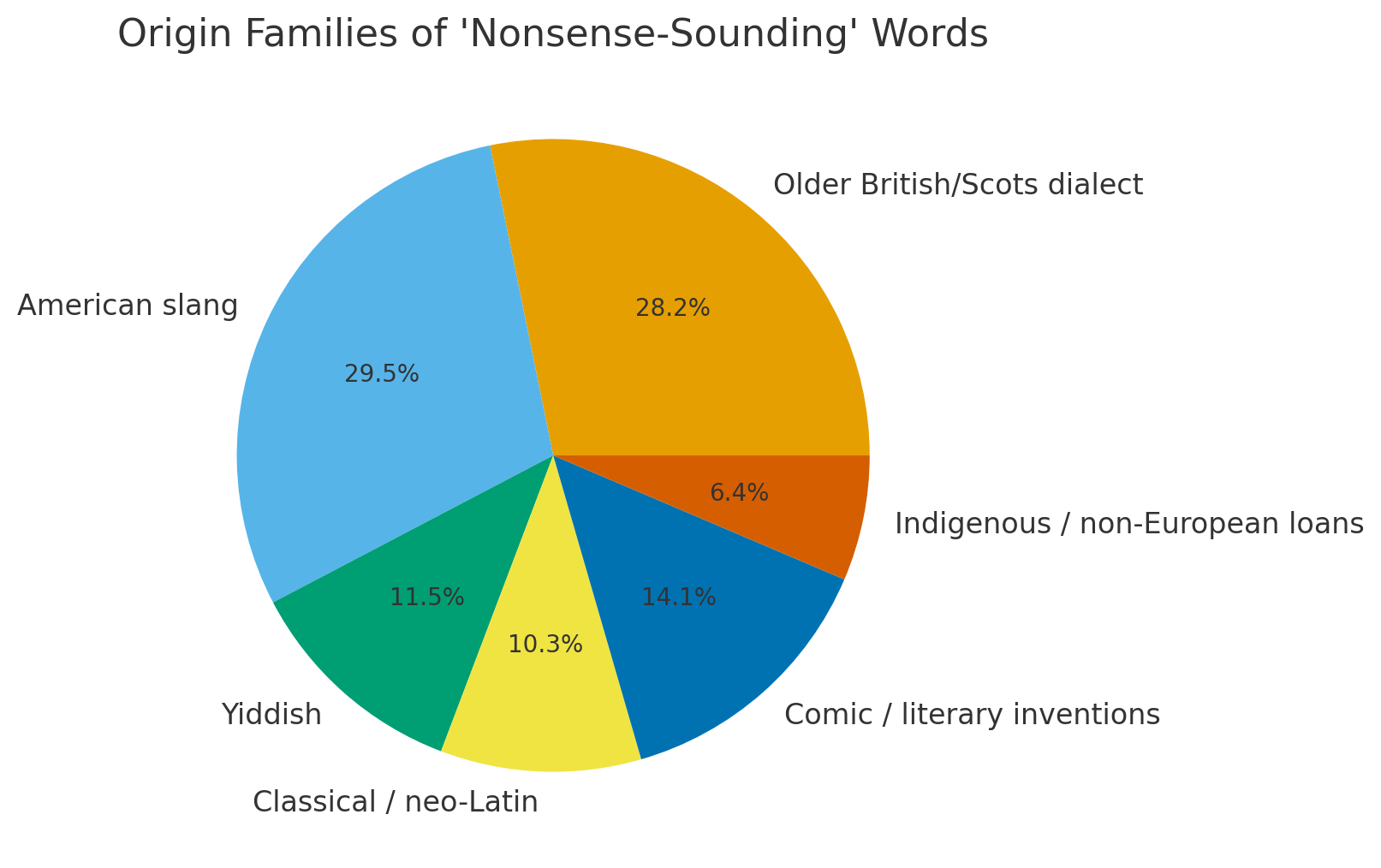
Etymologically, the list is less chaotic than it sounds. Certain sources and patterns keep recurring. Below is a non-exhaustive grouping that shows where many of the entries sit.
Yiddish and Hebrew into English
A number of the most delightfully “made‑up” sounding words in English are, in fact, perfectly serious arrivals from Yiddish (often via New York English):
- chutzpah
- bupkis
- schlep
- schlocky
- schmear
- schmooze
- tchotchke
To an English-only ear, the consonant clusters and rhythms can sound like nonsense; to a Yiddish speaker, they are perfectly normal words doing perfectly normal work.
Scots, Irish, and British dialect
A second cluster comes from Scots, Irish English, or older British usage:
- deasil — “sunwise,” clockwise.
- donnybrook — originally a Dublin fair noted for rowdiness.
- skewiff — askew, crooked.
- widdershins — against the sun, counterclockwise.
- namby-pamby, lackadaisical, piffle, poppycock
Much of what sounds like nonsense in modern standard English is simply older or regional English still doing its job elsewhere.
American coinages and U.S. slang
Many of the high-energy, comic entries are from American English in the 19th and 20th centuries:
- absquatulate, highfalutin, malarkey
- boondocks / boonies, bumbershoot
- cockamamie, discombobulate, recombobulation, combobulated
- hootenanny, doodad, doohickey, thingamabob, thingamajig, whatchamacallit, dingus
- simoleon, loonie, toonie, doubloonie
- skosh (via U.S. military contact with Japanese sukoshi, “a little”)
- winningest
These words often start as jokes, newspaper coinages, or regional slang and then stick. Their “nonsense” quality is often just unfamiliar morphology: they don't look like the prestige Latin and French that dominate formal English vocabulary.
Classical and neo‑Latin
Some entries merely sound overblown because they use classical roots in slightly baroque ways:
- acephalous, chirality, cubicularius
- defenestrate / defenestration
- matutinal, susurration
- prothonotary, territory
- palindrome, onomatopoeia
To people without a classical background, the shape of these words can feel like an exaggerated parody of Latin — even though their structures are perfectly regular.
Indigenous and non‑European loans
A smaller but important set comes from Indigenous or non‑European languages:
- ahuacatl – from Nahuatl; ancestor of avocado.
- guacamole – from Nahuatl via Spanish.
- didgeridoo – from Australian Aboriginal languages.
- nanuq – Inuktitut for “polar bear.”
- mulligatawny – from Tamil via Anglo‑Indian cuisine.
English learners sometimes assume these are “fake” simply because the sound patterns don't match Germanic or Romance expectations. In reality, they are evidence of contact with entirely different phonological systems.
Comic and literary inventions that “took”
Several entries were born openly as jokes or literary devices and then escaped into wider usage:
- cromulent — coined in The Simpsons.
- panjandrum / pajandrum — 18th‑century literary nonsense.
- transmogrify / transmogrifier — earlier literary use, later popularised by Calvin and Hobbes.
- thneed — Dr. Seuss's The Lorax.
- twitterpate — Disney's Bambi.
- contrafibularities, interfrastic, obflisticate, hugeous, terror tree — playful pseudo‑technical or poetic inventions whose citations are sparse but real.
These words are honest about their artificiality; their “nonsense” status is part of the joke. Over time, some of them become so familiar that only etymologists remember they were once punchlines.
Reduplication, sing‑song, and placeholder forms
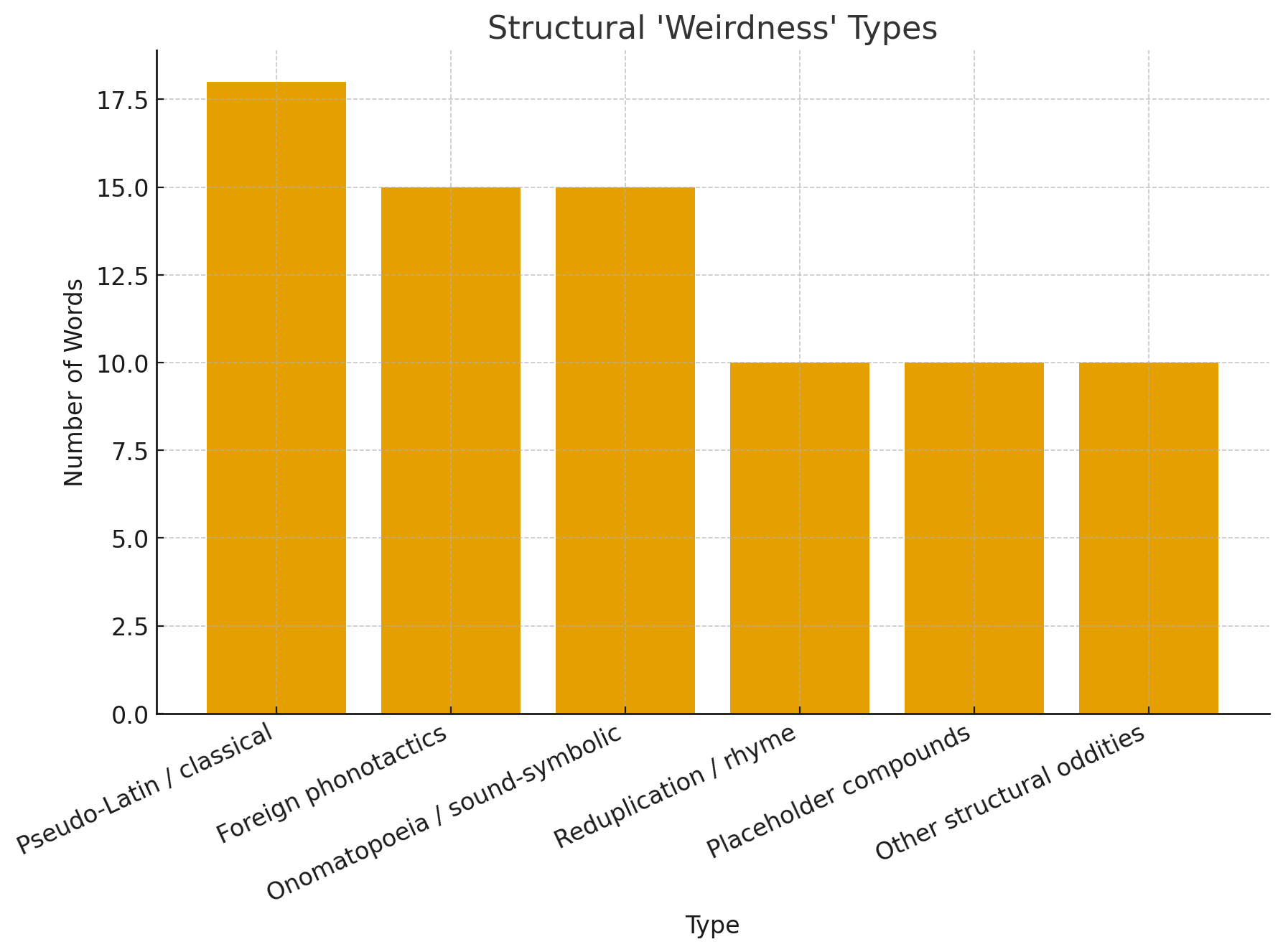
A final pattern is structural rather than historical. Many words sound like nonsense because they use reduplication, sing‑song rhythm, or placeholder structures:
- dilly‑dally, higgledy‑piggledy, la‑di‑da, namby‑pamby, shilly‑shally
- thingamabob, thingamajig, doodad, doohickey, ojamaflip / oojamaflip, wossname
Here, the “nonsense” is the point. These forms allow speakers to talk around a forgotten label, soften criticism, or inject play into otherwise ordinary sentences.
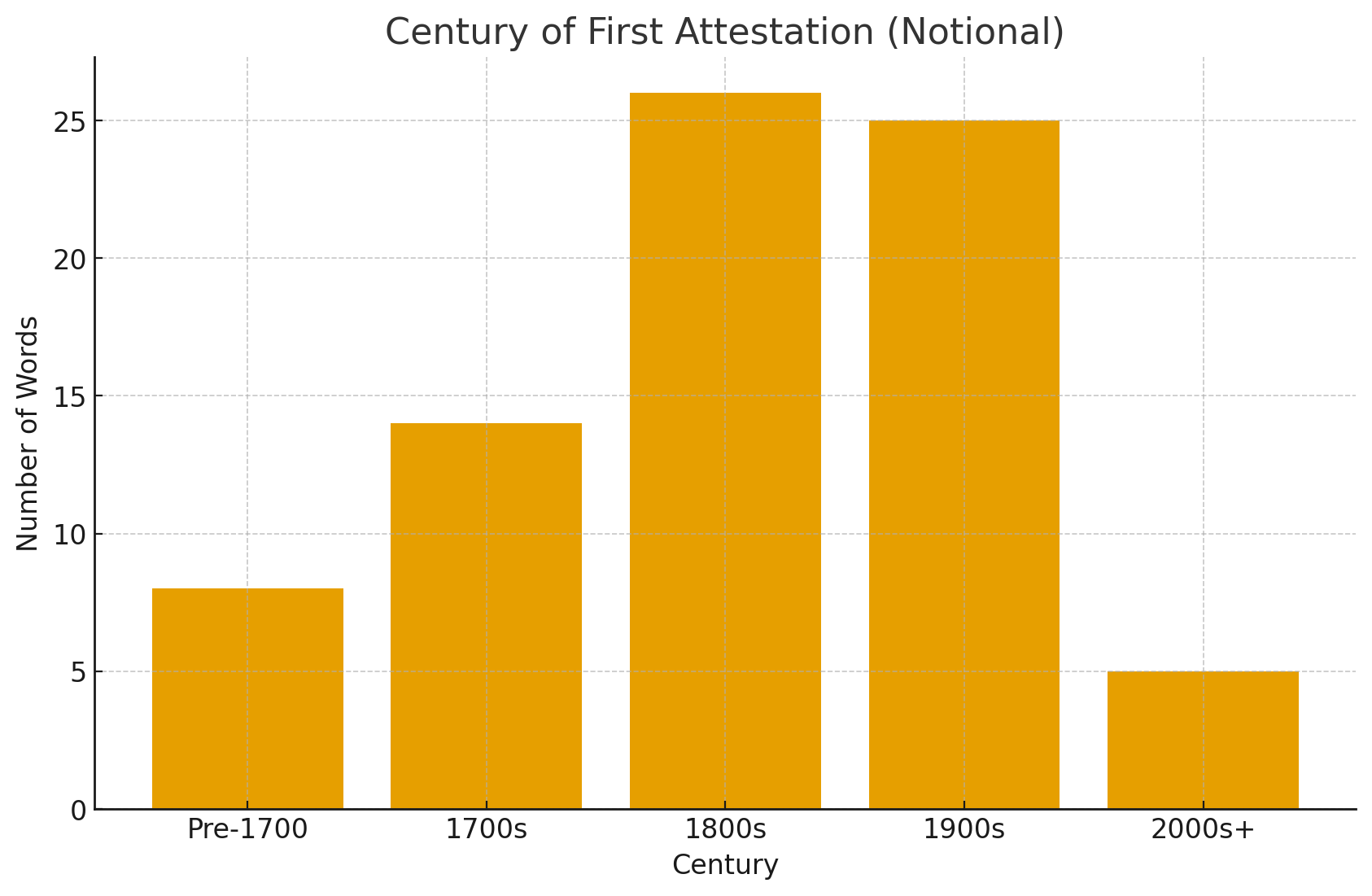
4. Three quick “charts” in prose
If you were to turn this catalog into literal charts, three patterns would stand out.
5. Why this kind of list matters
At one level, this is just a pleasing pile of oddities — the sort of catalog lexicographers keep in their pockets for dull train journeys. But it also illustrates three quiet truths about language:
- Nothing is inherently “nonsense.” A word can feel entirely made‑up to one community and painfully ordinary to another.
- Play is one of the engines of change. Many of the entries here began as jokes, comic exaggerations, or half‑serious slang.
- English is a memory, not a design. It remembers jokes, dialects, conquests, trade routes, cartoons, and scholarly Latin with roughly the same generosity.
The etymologists on Reddit were right: all words are invented. The interesting question is who invented them, why, and why some inventions never quite stop sounding like nonsense, even after they have done centuries of useful work.